Showing posts with label orixá. Show all posts

Thursday, May 7, 2009

Xango


Xango


Xango is one of the most popular Orisha in the candomble religion in Brazil. He is a Candomble divinity. In other parts of the world, Xango can be spelled in many ways. Xango is also known as Sango. Shango, or Chango. He is the God of thunder and lightning. Xango is the fourth king of the Yoruban kingdom and represents the Oyo people of West Africa. He controlled the powers of lighting an thunder. He died by suicide by hanging himself and entered the Yoruba pantheon. He is still celebrated in Nigeria and Brazil. Xango is known for justice, power, violent temper, magic, music and dance. He is a protector. He carries a double-headed axe, which represents swift and balanced justice. He owns Bata, the three double-headed drums. Xango makes all things double and is associated with the ram, a holy animal. His colors are red and white and his number is 6. His metals are stone and silver. Xango was a king who brought upon prosperity to his kingdom. Xango chooses his followers by pointing lightning at them. Followers who worship Xango have a sense of power and self-control. Xango originated in Africa in what now is now Nigeria. The orisha was brought over to Brazilian countries within slavery. The Xango traditions and ceremonies survived the passage and reestablished in the western part of the world. Now it is popularly known in countries such as, Brazil, Cuba, Puerto Rico, and Venezuela. Xango is one the most important orishas because he represents justice, by punishment. The axe is his weapon and represents his powers. Xango was feared for his ability to breathe fire from his mouth. Xango wears colorful clothes. His costume is white an red, and he wears a red skirt. Xango is an important orisha, that along with his mythological background and power, it is worshiped and celebrated in the countries it spread to.


History

Xango’s history has many stories. One of the stories tells about Xango’s parents. He is the son of Anganju and Obatala. Obatala is the king of the white cloth. He meets Anganju when he was traveling and had to cross a river. Aganju was the ferryman and god of fire. He refused Obatala passage. Obatala left and came back as a beautiful woman. Obatala went back to the river and exchanged his/her body for passage from Aganju. Xango was the result of this encounter.

Xango has many stories. Another story talks about him and his three wives. His three wives are Oshun, Oba, and Oya. Oba was his first wife, Oshun his second, and Oya his third. Xango’s three wives lived surrounding him. He lived, ate , and slept with all, every time he visited them. His favorite wife is Oshun the river goddess, because of her cooking. Oba is another river goddess. She becomes jealous of Oshun and Xango‘s relationship. Oba asks Oshun what she does in order to have Xango happy with her. Oshun did not like Oba because her children would inherit Xango’s kingdom; since she is Xango’s first wife. Oshun decides to tricks Oba and tells her that she needs to cut off a piece of ear and serve it to Xango when he eats. This will cause Xango to desire Oba’s food and bring him happiness with her. Oba does as she is told, but instead of cutting off a piece of her ear, she cuts her entire ear and serves it to Xango for dinner. Oba believes that by serving Xango her entire ear, he will forget about Oshun. As Xango eats dinner, he comes upon the ear and believes that Oba is poisoning him. He forces her to run away and she falls to earth and turns into a river. Due to this, now Oba is worshiped as the patron of matrimony. Oya is Xango‘s third wife; she stole Xango’s magic.

Xango has many mythological stories that originate from Africa. They all were transported to countries in South America and the Caribbean during slavery. Today, Xango is still worshiped by Yorubians. Yoruba is the most populous tribe in Africa, located primarily in Nigeria.

Xango Dance

Xango features rhythms of Santeria dancers who spin with bowls with flames and eat fire. Xango dancers wave their axe, holding it firmly with their hands. The axe is very important to the Xango ritual, because it is what represents Xango. Xango dance comes from west African ancestors and gods. The dances use a lot of drum beats and atabaques. Xango also dances around as if riding a horse. The dances are performed as rituals, were animals are sacrificed.


Xango Music and Instruments

Xango is a mixture of African Rhythms and Caribbean sounds. The music uses a lot of drum beats and clapping. The main language Xango music is sang in is Portuguese, including a lot of musical instruments. Some instruments used for Xango music are:

Ÿ Chere or Chechere: This denotes several types of mental shaker. The one Querino illustrates, used in Xango ceremonies, is a copper vessel containing pebbles.

Ÿ Adja: Small metal bell used in candomble and Xango ceremonies.

Ÿ Batas: Small wooden drums of Yoruba origin, used in Xango ceremonies.

Ÿ Ubata: No description known. May be alternative name for bata drum used in some Recife Xango ceremonies.


Cynthia Lopez

Works Cited

1. Eliade, Mircea( Editor in chief). The Encyclopedia of Religion. Vol. 3. Macmillan Publishing Company, New York, 1987.

2. http://www.geocities.com/beargomke/Xango.html

3. http://www.amazingpsychicreading.com/shango1.html

4. http://www.nickbuxton.info/photos/brazil/photo037.html


Iemanja


Brazil’s unique scenery and natural environment only complements its rich religious background in the Yoruba and Candomble religion. It is one of the few cultures that have maintained its roots and its tradition from its original native land, Africa. This African musical heritage can be seen in days of celebration when Orixa’s are summoned. One of the main Orixas that is celebrated is that of Iemanja, the goddess of the sea. This deity is the mother is thought to protect and care for all living creature. Here we will further explain the Iemanja’s character and role in the Candomble religion

Yoruba

The Yoruba religion originated from Nigeria, Africa, but during the slave trade this religion morphed into Candomble. One of the reasons why this religion was not eradicated even though many pursed it was the fact that Candomble synchronized Catholic Saints to Orixas (Fryer 14). Since all slaves came from distinct region of Africa the community was divided not only by language but also by customs and traditions (Fryer 42). In order to unify the slave community the Candomble religion was used as a common ground on which all African could stand on. This transition was easy because Candomble used similar “language, pantheon, liturgy, musical instruments and musical styles (Fryer 14).” The exact traslation of Condomble is “house of black customs (Fryer 42).” Meaning that it served as a refuge from the hardship of slave life. This mystifing religion is still practice through out Brazil and continues to merge many people .

Candomble

The Orixas's of Candomble usually represent symbols such as “colors, songs, anecdotes, objects, animals, plants, and atmospheric phenomena (Fryer 14).” Not only do they have their own symbol but they also have their specific accoutrements and rhythms. The one instrument that all Orixa uses in their dances are the drums; they set a steady beat while allowing the dance to have its unique tempo by using traditional instruments. Some of the traditional instruments can be seen below. To summon any Orixa the ritual must be performed with drum. As stated before drums are the main instruments that are used in both Candomble and Yoruba religion (Fryer 18). Once the Orixa has been summoned it will salute the drum master and proceeds to carry out the ritual. The most influential Orixa of Brazil is that of Iemanja. Because Africans where not allowed to worship her in Latin America she was associated with the Catholic Saint “Our Lady of Conception or Our Lady of the Navigators (Fryer 18).” Iemanja is usually seen holding a brass fan while her costume consists of various white and blue hues. These agglomerations of symbols emphasize the role of Iemanja as a protective mother with in the Candomble religion.


Number

Name of Instrument

Description and Function

1.      

Adjà

Small metal bell used in Xango Ceremonies

2.      

Ilu

Large wooden drum of the three Atabàque drums,”1.1 to 1.4 meters high pronounced rum (Fryer 18)”, used in most Candomble ceremonies. 

3.      

Agògò

Clapperless double bell, stuck with metal stick. Used in Candomble ceremonies “sets the fundamental pulse at eh start of each song (Fryer 19).”

4.      

Baquetas

Drumsticks

5.      

Atabàque

Stick beaten drum comes in various sizes. Used in Candomble, often made from “barrel staves (Fryer 18)

6.      

Chocalho

Various types of shaker

7.      

Rumpi

Medium-sized drum of the Atabàque drums, made out of goatskin  (Fryer 18)

8.      

Smallest drum of the Atabàque drums, made out of goat skin  (Fryer 18)

(Fryer 162)

Iemanja Movements and Image

Every Orixa had their own movement according to their element or their natural space. Iemanja is the goddess of the sea. She is usually dressed in blue, as a way of representing the water while white is the foam that is produced when the waves crash against the rocks. All of Iemanja’s movements are affiliated with the sea thus most of the basic movements follow a fluid water like rhythm. In order to properly portray Iemanja one must claps both hands as if drinking water. The main dance is done this way. Another way that Iemanja depicts the sea is by using her skirt to imitate the movement of crushing waves. One aspect of her footwork is associated with a mermaid therefore one of her movements encompasses the bending of the knees.

All images of Iemanja are presented with a central theme: the ocean. As described before she is the deity of the sea therefore most of her images are seen at sea. The body of Iemanja can be presented in two ways: a human form or a mermaid. The background consists of animals such as dolphins, fishes or any ocean life. There are three other forms of Iemanja while all of them have the same basic element, water, they do differ in meaning and in water context. Take for example Iemanja Nana Borucum this Orixa is the embodiment between earth and water. Iemanja Bomi is often represented as a young woman with wisdom. While on the other hand Iemanja Boci is the sea that touches the shores she is often associated with motherly love (Jlè Axè Bomi: Cabana de Pae Oxossi).

http://www.geocities.com/ileaxebomi/Iemanya.html

Location of her Procession

Rio of Janeiro is one of the smallest estates in the Brazil. Yet its size may be small but Rio de Janeiro is has the biggest city of Brazil. It borders Sao Paulo and Espirito Santo making Rio de Janeiro rich in culture and tradition. Since Iemanja is the deity of the sea many people will gather on the shores of Rio de Janeiro. This is the main area where the processions are done.  As offering they will throw flowers, perfume and jewelry into the bay. Many of her followers will toss these items into the sea in hope of it being exchange for a wish. If the item returns to the shore the wish will not be granted. That is why many hire boats so the items are thrown far away from the shoreline. Those who cannot afford boats they will make hand made boats and launch them from the shore. Others on the beach will make sculptures of Iemanja or dig hole in which they place candles. The offerings are left at local community center where boat will gather them and take them to sea. At four in the morning boats will usually drive about 6 miles into sea and deposit the offering. Mean while those on shore will enjoy the celebration and wait the New Year morning.  This is one of the reasons why Iemanja is the most celebrated deity because it signifies the beginning of a new year.

Music in honor of lemanja

http://www.bahia-online.net/festas.htm


Works Cited

Fryer, Peter. Rhythms of Resistance: African Musical Heritage in Brazil. London: University Press of New England Hanover, 2000.

Jlè Axè Bomi: Cabana de Pae Oxossi. Jlè Axè Bomi: Cabana de Pae Oxossi; IEMANJA Ile Axe Bomi's Orixa. 7 May 2009.

Iemanja Song 

Logum Ede


Axel Santana

Anna B. Scott

Brazilian Dance

May 7, 2009

A Tale of Orixas: Logum Ede

1st Things 1st- Candomble

-According to Professor Anna B. Scott, the definition of Candomble is- “a holistic system, it is comprised of culinary arts, apothecary, the art of placement, healing with colors, visual arts, music, poetry, oral literature and dance.” In the traditional Brazilian religion known as Candomble, there are many rituals performed. Within each ritual, there are various elements that form the basis of the music that is played, the food that is eaten, the materials used, and the movements that are made. This religion had its roots in the African-influenced city of Salvador which is the capital of the region of Brazil known as Bahia..
View Larger Map
Although this religion is practiced chiefly in Brazil, it is becoming increasingly popular worldwide. “The rituals involve the possession of participants by Orishas, animal sacrifices, healing, dancing and drumming” (tudobeleza). The name Candomble means “dance in honor of the gods” and music and dance are very important factors in the tradition (BBC). In its early days, Candomble was practiced secretly since the Catholics wanted to keep the enslaved Africans under their control. Practitioners would conceal their deities under corresponding Catholic saints (BBC). There are a number of deities that make up the polytheistic religion of Candomble, and they are known as Orixas, and this blog, we will be discussing one Orixa in particular- Logum Ede- the various elements that go into his/her rituals, and dance.

Orixas

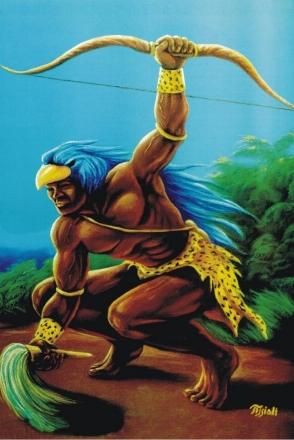
-Are the gods of this religion and are characterized by particular symbols: colors, songs, anecdotes, objects, animals, plants and atmospheric phenomena (Fryer- Rhythms of Resistance). From birth, everyone has their own Orixa dedicated to protect them- which would be equivalent to a Catholic person praying to a specific saint. There are over a dozen different Orixas, each with a varying purpose than the next. Some examples are Oxossi, who is represented by a bow and arrow, and whose color is green; Ogum, who carries a machete, and whose color is red or green; and Xango, who has two axes, and whose color is red or white. Some other Orixas include Exu, Ogum, Omolu, Ossain, Oxumare, Iemanja, Iansa, Nana, Obatala, and Logum Ede. In this blog, we will find out just a little bit more information on this Logum Ede character to see just what he or she is all about…

Logum Ede: Background Check

Born to Oxossi Matalambo and Oxum. Oxossi embodies mental wizardry especially in debates, verbal agreements, and negotiations. He is represented by a bow and arrow, while iron is his metal, and bushes are his natural element with green as his color. Oxum is known as the patron of artists and all things beautiful as she protects pregnant women and their fetuses. She is represented by the mirror and brass, while her color is yellow, and her element is the river (choreostories). Living up to her name as the “desirable diva,” Oxum was able to seduce Oxossi, and that was how Logum Ede was conceived. There was some controversy as to how he came to be, since Oxossi denied paternity for the longest time. During conception, another Orixa, Nana- who relieves the suffering of anguished mothers- was present. After all this, they managed to raise a child who knew the secrets of the medicinal herbs, had the bless of cure and the knowledge of the preparations of the portions.

Logum Ede: Orixa in the Flesh

Obviously, in the footsteps of his father, Logum Ede boasts his agile abilities with his weapon the bow and arrow (though the hand gesture for his is formed with the reciprocal to that of his father’s). Known for being the Orixa of double personality, Logum’s social role is the Hermaphroditic hunter. Also known as the mermaid warrior, his metals are brass and iron (a combination of his mothers’ and his fathers’). Waterfall in the mountains is his element, and his color is green, naturally. Logum is acknowledged for being able to traverse and thrive in impossible terrain (choreostories). He is god of everything that ails humans, as much as plants, fish, and other animals, and embodies the beauty of masculinity (http://www.umbandanossa.hpg.ig.com.br/logun.htm). His fruit is the banana prata, and the cacau e obi. His flower is the rose and his food is axoxo e omolokum. Logum is known for protecting fishermen, spreading overall wealth, especially to those who do not have any.

Children of Logum Ede:

People born under him are known to be very charming and charismatic, and therefore have many friends as well as admirers. They tend to have tremendous passion for people who suffer and do all they can to assist them. Despite these attributes, they are irritated quite easily, and lose their temper frequently. Most are perfectionists and must have their own way, and do not admit their faults. Many times, they will act on impulse, taking advantage of everything that life has to offer. Children of Logum Ede are curious experts, and are fully interested in taking on new experiences. Just like their Orixa, these individuals can adapt to any environment or situation.

Wrapping It Up

Now that we have learned a bit about this interesting Logum Ede character, let us watch a video on some of themes that were brought up. As we watch, try listening to the lyrics, and see if you can recognize any of the words that are sung throughout the song. Logum Ede is one of the most unique Orixas, because of his complex childhood, as well as his versatility when it comes to gender. Despite his obvious similarities to his father, Oxossi, and his close upbringings to his mother, Logum Ede was a whole new character in his own. He is the patron of fishermen, and waterfalls in the mountains, and his close relationship to water, symbolizes the power of peace and harmony.

Works Cited

"Myth of Logum Ede Birth." Babalorixa's Words. 6 May 2009 .

"Religion and Ethics- Candomble." BBC.com 2 Feb. 2007. BBC. 6 May 2009 .

Tudobeleza. "Candomble: Afro-Brazilian Religion." Weblog post. Word Press. 6 May 2009 .

Verger, Pierre. "Logun Ede." Lendas. 6 May 2009 .

>.